Shri Vidya

Radio Article # 1 :My Radio Interview about Indians in Perth

My radio interview about the exponential growth of Indian population living in Perth in last 5 years and how they are supporting each other using social media.

Tune the digital SBS radio 2 (the radio on TV too) at 4:00 to 5:00pm today. Or Stream from Website http://www.sbs.com.au/yourlanguage/gujarati
if you missed the live broadcast.
Search for the radio program of 8 and 10 April 2015
Please like SBS Gujarati Facebook page to get updates.

23 year old trashes BBC documentary despite being an Indian woman

What a view point of an Indian girl on BBC Documentary-“India’s Daughter”
Please dont generalise us….

feardomofspeech's avatar

cropped-img_02871.jpg

A million status messages supporting the BBC documentary film.  Thousands of anti-government slogans for banning the BBC documentary film. Another million status messages against the German professor who created a perception after seeing the very same documentary film we fought for.

What do we really want? It seems like we just love being part of a “trash everything” movement.  Let’t admit it. We love the attention.  We love the controversy more.

“India’s daughter”, the BBC documentary film, as I see it was made for foreigners.  If I wasn’t from here and I learnt that a women was raped every 20 minutes through the film, I would have been a little scared of Indian men, you know?

This is what I took away from the film:

1. The rapist defended and justified his actions.(especially when the case is still pending in the Supreme Court). Wow. So unnatural.

2. The lawyer appointed…

View original post 295 more words

11# Naari : The Women- Your Daily Life Goddesses

Excerpt from Manusmriti 3.56 Reads:

Sanskrit:

Blog#11

English :-

Yatra Naryastu Pujyante Ramante Tatra Devata Yatraitaastu Na Pujyante Sarvaastatrafalaah Kriyaah ।।

Meaning: “Where Women Are Honored , Divinity Blossoms There; And Where They Are Dishonored , All Action Remains Unfruitful.”

“Nar” in Sanskrit means “Man” and “Naari” means “Woman”. It is said that “Naari tu Narayani” literally means “Woman you are world creator, preserver and protector.”

Woman is the energy of anyone’s life, very right from the beginning of anyone’s life. When any life is born, it is born through a female in the nature and humans are not an exception. Our life starts from the woman; she is the Adi Shakti (First Energy) of anyone’s life. The woman is the source of mankind and without her the human life wouldn’t exist on earth. The love, care and sacrifice of the mother (including Mother Nature) for her children is matchless, selfless and of course priceless.

I praise the divine qualities in every woman which are compassion, love, care, sacrifice, sensitivity, emotions, life creation, forgiveness and strength. The women are considered the sources of Astha Aishwarya (Eight Wealth) – prosperity, good health, knowledge, strength, progeny, and power.

Blog#11#2

Woman is the Saraswati (Goddess of Wisdom) when she bestows you a knowledge and wisdom in the form of advice and teaching right or wrong. Woman is the Lakshmi (Goddess of Wealth) when she prospers you by showering happiness, providing motivation and opportunities in the life. Woman is the Kali (Goddess of Power) when she strengthens you to reach out to your maximum potential by destroying your all fears obstructing your growth. Woman nurtures our good health by preparing and feeding us a nutritious and delicious food and motivating for keeping active healthy lifestyle. Only woman can bless us children, she is the only source of creation of the human life.

Women must be respected, honoured and acknowledged for what they contribute in our day-to-day life and in any good aspects in the world. As a daughter and sister she must be adored as a princess, as a wife she must be loved as a queen and as a mother she must be worshipped as a goddess. By not appreciating woman in the society, you are disapproving love, care, source of life, emotions, family, values and empathy not only from your daily life but also from the entire mankind.

On this International Women’s Day, I acknowledge my respect towards my Shakti- my life energies which are/were women in my life in the form of my grandmothers, mother, wife, sisters, daughters, friends and colleagues. I also bow to all live goddesses of the world who contributes to their families, cities, societies, communities, environment, space, nations and more many more areas which are ever thought about.

“O our Tri Shaktis (3 Powers) – Saraswati, Lakshmi and Kali ! May bless this world Wisdom; Wealth and Strength to overcome the ignorance, poverty and fear. You have enormous potential to inspire us to create your divine qualities within.”

Please share this article if you truly believe in appreciating the women’s contribution in the world.


10# Happy Holi

May this Holi fill the remaining colours in your life, you enjoy and get fullfilled with the colours of love, empathy, sensitivity, sacrifice, tolerance, care and dedication.May this Holi bring strength in you to overcome the evils (Holika and Hiranyakashipu) of your own mind and to transit towards goodness and eventually supreme divinity (Prahalad and eventually Vishnu). Happy Holi to all friends and family.

image

image

image

9# Gyan – The Wisdom Which Liberates

Shlok

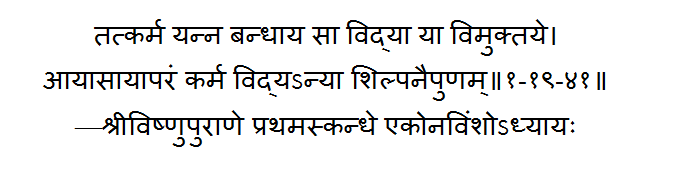
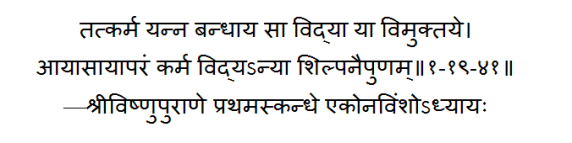
tatkarma yanna bandhāaya sā vidyā yā vimuktaye| āyāsāyāparaṁ karma vidya’nyā śilpanaipuṇam||1-19-41|| —śrīviṣṇupurāṇe prathamaskandhe ekonaviṁśo’dhyāyaḥ

That is action, which does not promote attachment; That is wisdom which liberates [one from bondage] All other action is mere [pointless] effort/hardship; all other knowledge is merely another skill/craftsmanship.

Above words are the wonderful Sanskrit shlok couplet which clearly sing the glory of the wisdom. It clearly says acquiring wisdom is the only action which does not create attachment to this material world only liberates one from all the bondage and one’s prejudices, negativity, ignorance greed and so on. Taking hardship for other material things is aimless and which will never satisfy your hunger only will create the attachment to them. Without wisdom all acquired information and knowledge is pointless.

From the birth to around 4-5 years of human life, the humans start to learn basic life skills like eating, walking, speaking, thinking, socializing etc and values like empathy, love, care etc. The most skills they learn, are from home and the environment around from own experiences.

As human grows,He/she goes to any external educator like schools. That shapes the discipline, responsibility, accountability, analytical skill, imagination and so on in the human. Still the hunger for wisdom differ the person from another.

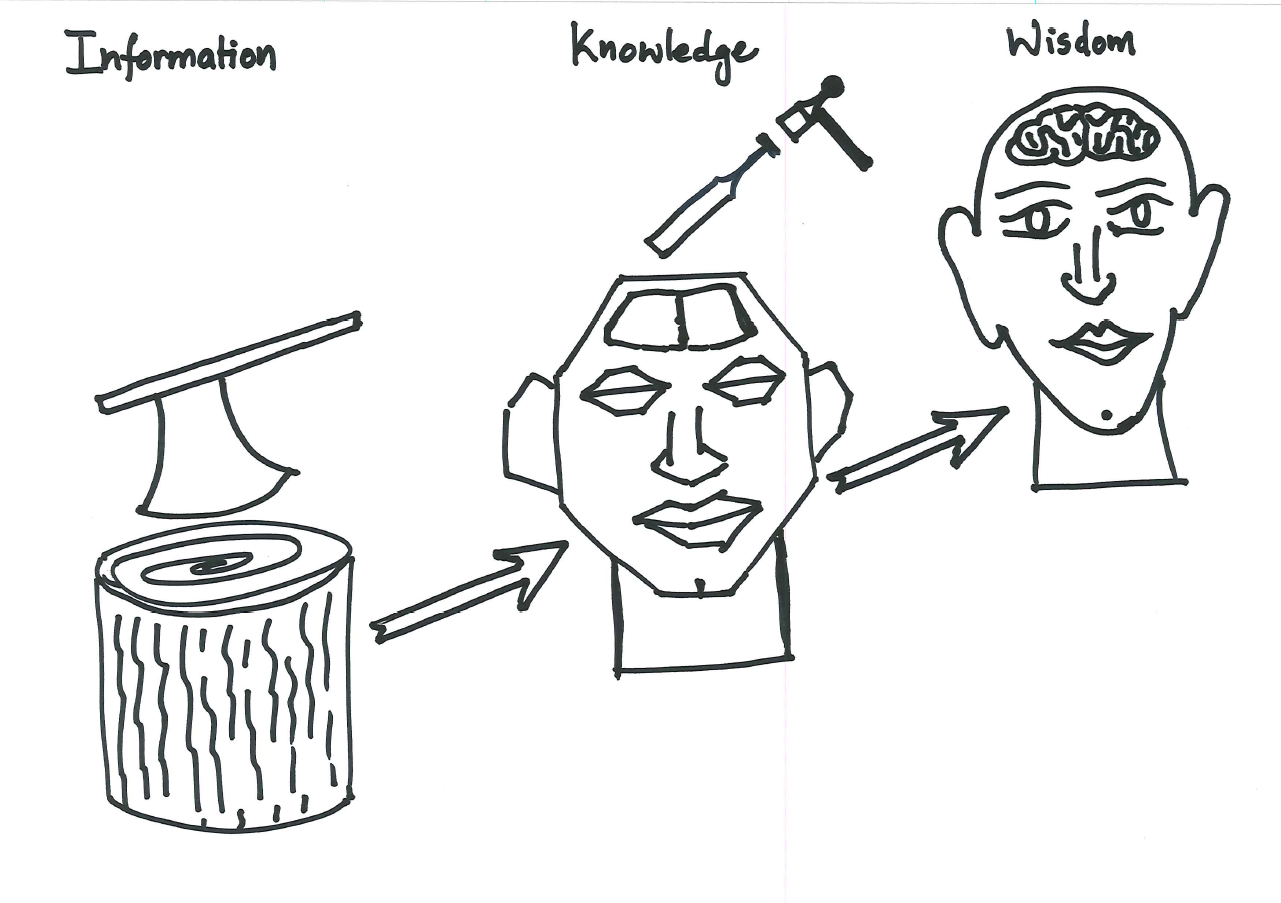
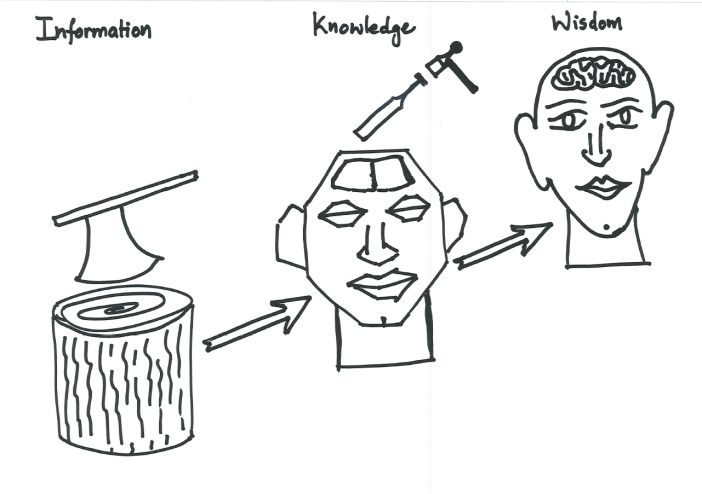
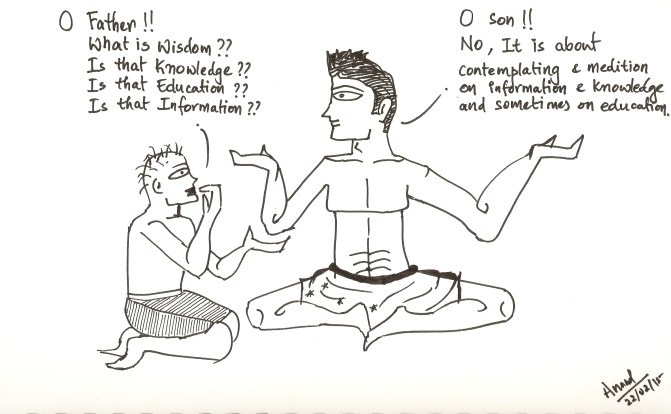
The education, information, knowledge and wisdom are unique and different facets of the human learning process.

Education is the formal learning process which person may have to go through regardless of the interest.

Information is the set of facts which you know when someone need to or have to know about something or someone. It is need and interest driven learning.

Knowledge is the combination of different facets of the learning. Deep understanding derived due to own or someone’s experiences from formal or informal education and the application of the information in the life situations.

Wisdom is the ability to apply education, information, knowledge, values, common sense, intuition, belief and experience while responding to particular life situation. By using wisdom makes you happy about the decisions you have taken and problems you have solved. This is the best possible ability can be derived from all the learning human can obtain from various forms. Customised wisdom applied on the particular life situations.
Wisdom

In Hindu ancient scriptures and texts, the four Ashram (phases) and Purushartha (meaning/goal of existence) of the life are described. The average human age was divided in 25 years’ phases. The Ashram and Purushartha divided into 25years each.

Human Age (Years) 0 to 25 26 to 50 51 to 75 75 till Death
Ashram Brahmacharya (Being the Celibate Student) Gruhastha (Married Family Man) Vanprastha (The Hermit in Retreat) Sanyasa (The Wandering Recluse)
Purushartha Dharm (Acquiring the Wisdom) Arth and Kam (Acquiring Wealth and Pleasure) Arth and Moksha (Acquiring Wealth and Liberation) Moksha (Acquiring Liberation)

It clearly supports acquiring the knowledge into first phase of the life when a person generally has good memory and grasping capacity; fresh mind without worldly set rules; good imagination power and no household worries, which enables him/her to learn and acquire knowledge about future opportunities, threats, duties and responsibilities in the life.

Asking questions “why” and “how” of the information is the key to get deep dive into the information. “Why we are learning this? Or why this information is required?” will give an insight of the need and “How can you use the information or education to solve the problem or get things done?” will allow to think the application of the acquired information. When a human remembers and relates the “why” and “how” of information used in various situations in the life which is called life experiences, the mind slowly transforms the information into the knowledge.
Blog#9#2

The school system of ancient India called Gurukul, which literally means living in the teacher’s domain, was set up for students who were required to live and study in teacher’s house being a part of their family by learning 14 Vidya (Techniques) 64 Kala (Art forms). Even all royal children were expected to live the life of celibate student which was not different than any other student. The main aim was to teach them reality of the life if future prince may have to face. Ram-the prince of Ayodhya is the prime example of the princely student who learnt and experienced all the hardships and reality of the life during the phase of student life made him aware with the ground reality of human life which is considered knowledge. When he destined for his 14 year exile period, he could concentrate on his Tapa (effort to achieve self-realisation,which can be considered as wisdom) than his discomforts which were quite opposite to his royal luxury. This shows how acquired knowledge enables a knowledgable prince into the ideal rule upholding king can be worshiped as a god.

Acquiring the knowledge and turning into the wisdom takes time,persistance and patience. By being exposed to various life changing experiences and then doing Chintan (thinking or meditating) on those experiences by using acquired knowledge.Finally wisdom floats like butter(Wisdom) floats by churning the curd (Knowledge) .The wisdom is not easy to achieve as that requires a person should have some prerequisites like education, information, knowledge, values, common sense, intuition, belief and life experiences and many more things. Hence getting wisdom in first two phases of the life is hard because human is acquiring all the prerequisites unless the person is passionate about it.

May goddess Saraswati give you wisdom and liberates from all the matrial bondage.

P.S. Dedicated to my son-Avyukt’s first day to school.

8# What do you want to be? Diplomatic or Real?

“No legacy is so rich as honesty.”- William Shakespeare

“Always stand on principle … even if you stand alone.” by John Quincy Adams (the 6th US president)

We think, someone is honest, narrow or real while he/she is dealing with the life situations? Is it so? Or Is she/he “practical”, open or diplomatic?

We have always been taught that “honesty is the best policy.” but in real life situation are we able to stand on those principles?

Being honest or real for someone is to be courageous (great quality) and most of the time it is risky (drew back) too. It is risky to the relations, career and life but on other side it is rewarding too.Being honest in the life situations may be bitter as truth however it may reap good rewards if it is taken positively. For example, An academically poor student has been told to get improved in academia may be bitter for a student in the student life timeframe but they will appreciate the importance of good education and learning in the life once they will be benefiting from that education. The major risk is to the “truth speaker”, in above example is teacher or parents, to lose their nice and glossy image in front of those students and sometimes fear of getting hurt their own ego due to the opposition or disobedience. However in longer term the “truth speaker” will be remembered for his/her views as compared to the person without expressing any views or pampering the students.

Being diplomatic may be sweeter than a honey however it may create your impression as “fair weather person” or “person without principle” among general people. Taking the same example if students are pampered regardless of poor academic performance just to keep nice and glossy image of teacher up in front of the students, he/she will be cursed once they will need to use the learning from that academia. Then  the teacher loose his/her lovely  image forever. Only people were remembered in the history who lived  and stood on their principles. Even politicians, who have been too diplomatic, never been remembered by the history.

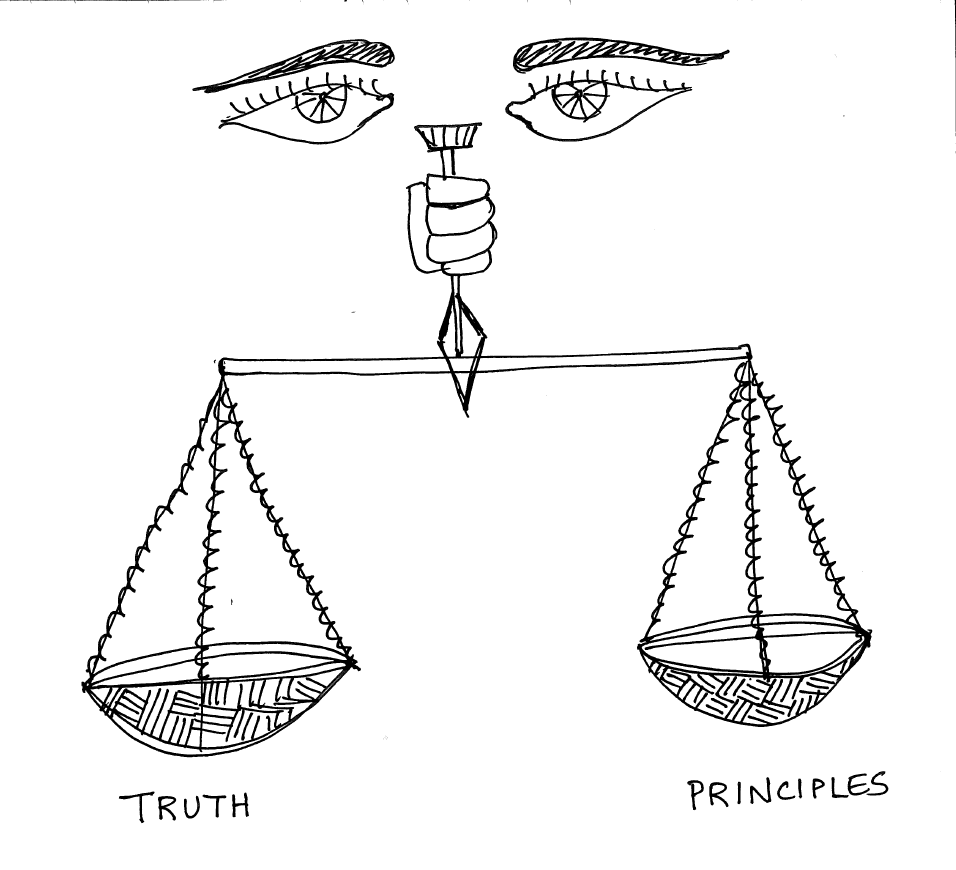
Truth and Principles

In Indian epic Mahabharata, while there was a time for Dharma Yuddha -“War between good and evil”, Shri Krishna, godhead personality, himself took the stand on his principles and truth, so he supported the Pandavas – the five brothers who were fighting to regain their kingdom which was denied to return by Duryodhana and his brothers – Evil minded cousins of the Pandavas. On the same time Shri Krishna’s brother Shri Balrama, who was equivalent in the strengths to Shri Krishna, had chosen to be reluctant to participate in the war because he was supporting both of them. Later in the war, he cursed Bhim-the strongest Pandava for killing Duryodhana by not following rules of warfare then Shri Krishna told him politely not to intervene as he had a chance to stand on his views but he avoided to join the war of Mahabharata and he chosen to be good to both parties.

Sardar Patel-First Union Home Minister of India took his stand on uniting over 600 princely state into the one independent India. His bitter views about merging the states into new country and principles were opposed by Nehru and many other politicians otherwise there would be chaos in the region. He is now being appreciated by current generations ,While on the other side initially adored Nehru is being cursed for dividing the one nation in two nations -India and Pakistan. Gandhi is also being blamed for not doing enough to stop this divsion.They never regarded well in the history for this cause.

Being diplomatic is still good for the person where you need to treat each person equally at the work without standing on his/her own views. For example as a professional employee you generally stand on your employer’s view points and values same as politician who stand on his/her party’s principles.

But on the other side you need to understand and justify to yourself and the world how good are your principles overall or is it just your ego?

It is risky , It is scary , There is a possibility of being hurt even though be yourself however it doesn’t mean you hurt others.

What do you want to be diplomatic or real ?


7# पितृ देवो भव् – Remembering My Father on His Birthday

“मातृ देवो भव् पितृ देवो भव् “… (Taittiriya Upanishad) means Respects to Mother and Father. They are all forms of God.

I believe they are the only living gods we see in our life.

I am dedicating this article to my inspiration,friend,philosopher and guide – My Father.

He was a fourth child among six siblings born to educated farmer. His parents and my  grandparents Narayandas and Gangaben were a happy couple, working hard to raise their family with very small pack of land inherited by forefathers and were living in my native village Karbatiya (Ta. Vadnagar , India).

I heard from my father that his parents had to sell their most of their belongings over the time to give their kids a good education. My grandfather always believed that the education is the only way to transform to your spiritual and socio-economic status.The same belief percolated into my father due to his real life experiences.The respect and love for his parents was great.He did anything he could do to make them feel cared and loved. I rate him dedicated and responsible son.

My Father-SSC Photo

 A person being emotional , family , friends and native place lover was very popular in every community of our native village. Even today his friends still tell us his stories about all the mischief they did together and also how academically brilliant, handsome (actually people called him Rishi Kapoor in his school/college days) and brave was he? that makes us feel proud. I have seen his friends cried for him when he left us forever.Members of every community came to his funeral.That showed the love he received from his friends and community and vice versa.

I consider his love for his siblings and their kids was very sacrificial however it has never been appreciated. My cousins still recognise and accept the fact about his solicitude to our big family.

His love and respect to my mother was just phenomenal however he admitted that he could never give everything she deserved due to his illness and other commitments. He expressed regret in front of me in his last days that whether he could ever give her anything back what she has sacrified for us.

We two brothers of course were jewels of his eyes. His way to love us was quite a different.The discipline and health were main themes in his affection.We were denied other food if would not eat any healthy stuff like bitter melon :). A good thing was that he just motivated to be excellent at whatever we do regardless of type and level of work.That made us more pressure free in our career paths. The bedtime stories he told us included the stories of Ramayan,Mahabharat and Indian independence.Further he nurtured our hobby of reading and my natural fine art skills. As a Mukhya Shikshak at RSS Shakha (http://en.wikipedia.org/wiki/Rashtriya_Swayamsevak_Sangh), he took us there every evening.That encouraged our self-awareness of nationalism, morality, duties, leadership, equality and physical fitness. His teaching on moral values was practical, one of the real life experience when we kids bought chocolates from the shop and the shopkeeper returned us more change than it should be,we were happy kids because we got extra money by somebody’s mistake but eventually we had been brought back to the shop and told to return the extra bucks.We didnt like that initially but we felt respect about ourselves and our father for doing the right thing.

His motivation on our failures still reminds me that how positive was he.On the failures in the life exams and having the greatest disappointments, he usually said “you will have many other chances,this is not the end of life,on positive side you still can learn from your failures.”, to be honest he was damn right. Despite of his on and off 15 year bedridden illness , he was full of positivity and spirituality.He never got depressed because of his deteriorated health and eventually financial and other opportunities in his life. I don’t know where did he get that energy from? He always believed in “Law of Karma”. He always said that the reason of his suffering might be his Karma from his past life. He preached us to be conscious about our Karma and we are trying to be very conscious. We are taking our health very seriously because he gave his own example about how health is the real wealth.On kids development he used to say , “parents are the only best teachers in the world and we can’t just transfer our major responsibility of values and academic education to the kids’ school teachers only.”He used to say make good and long term friends and love them without any expectations.

I don’t know what people would have ever recognised him – just by his financial success or by his status? but for us he was our teacher, motivator, philosophical friend and a great father.

Would we ever be able to give such a wealth to our new generations? Would we be able to do such a great sacrifices for our parents ?

On his birthday today (23 November) he would have completed 60 years and we would have celebrated his Shasthi Poorti (http://en.wikipedia.org/wiki/Shashti_Poorthi).Unfortunately he is physically not with us since December 2007 but spiritually,by his thoughts and ideology he will be will us forever, generations to generations.

Love you dad and we need you today for ourselves and our kids.We acknowledge and appreciate your importance in our life. We know you are smiling and blessing us from the sky as Pitru (http://en.wikipedia.org/wiki/Pitrs).

Wishing you a very happy birthday Pappa and Miss you so much…………………………

6# Friendship Briefing

A friendship is the “volunteer relationship” a person would build during his/her life stages. The person’s life stage changes the perspectives to the friendship over the time. Some keep the relation same throughout the life and some changes due to factors like class-ism, importance, ignorance, avoidance and requirements etc.

I believe common types of friendship may have been seen are ,

  1. School/college Friendship : This is the honest and long-lasting friendship because it is not based on any hidden expectations/agendas. On the other side this is the tough to maintain because of the new friendships come along the path of the life.No expectations,no jealousy,tolerance and no hidden agendas are the factors which leads this friendship to its genuineness. Most of the friends of school times are always excited about everybody’s wellness and help.Even though they get little time to meet each other due to location,time,profession and other constraints.e.g. School friends’ meet always discuss about old good memories and everybody’s progress or helping each other.
  2. Nature Friendship: Nature can be a great friend in terms of loving a garden,river,mountain,forest,ocean or animals. This friendship generally is without any expectations.MOST SACRED FRIENDSHIP.
  3. Professional/Business Friendship : When the person enters into the profession, he/she starts making friends of same or different interests in the profession.The person generally spends one-third time of his/her day at the work so this friendship can be more deep and honest. This relationship could last longer till the death or till the job ends.It is entirely depend on how the relationship is maintained both way.This friendship is considered most volatile friendship.
  4. Social Friendship: The social friendship may be developed in many ways like relation with our kid’s friend’s parents, our neighbours or club members etc. This friendships generally changes as the priorities and needs of the person changes in his life during various stages of his/her life. Some people may find the social friendships are hardest to maintain over the time as same interest as it has been started. This type of friendship generally stay live when the friends are on same locations where they can meet regularly as soon as the location changes the friendship is getting blurrier and sometimes to the end due to lack of any communication.
  5. Family Friendship: People related via family,blood and other close means are falling into this category.This type of friendship is built due to the family known each other from long time.In family relation friendship,it has been seen many brothers,sisters,mothers,fathers,cousins,aunts,uncles and in-laws etc are friends of each others. This friendships are closely knitted friendships which may have lots of expectations too thus when this friendship get damaged,it hurts the most.
  6. Life Friendship : In this type of friendship,Only two persons can be your friend-one is your partner or yourself (God). Most intense relationship where you can share anything and everything.

Even though people surrounded by lots of friends ,why many of them are not happy with their current state of  friendship.

Here are the few reasons ,

  • Expectations : Expecting something from people is common but minimum expectations keep your friendship without complain.
  • Comparison : Comparing yourself with your friend is completely unjust to yourself as everyone is different in the fact of your priorities,needs,life journey and value system then why to compare? The difference make you more colorful than the dull uniformity.
  • Jealousy : Being jealous is common human instincts however once you understand what is your life journey about and nothing you can compare then there will be no space for jealousy.
  • Prejudice : A person who set an opinion based on the experience previously had from the person.It is unfair to yourself to keep going with the same thoughts. Be tolerant an accept the friend with new perspective. You may overcome from prejudice.

Friendship is the best relation in the world which can be maintained only by your dedication towards friendship,selflessness in the friendship,no calculations and less expectations.

In a simple words for any relationship “think about others before yourself they will do the same.”

Friends if you like my work please feel free to comment and share.

5# Management Concepts : Dharma – The Absolute Duty

Dharma is the term with multiple meanings in the Hindu,Buddhist,Sikh and Jain philosophy. It is a central concept of the way of living.

Dharma translates into the duty, law, righteousness, rights, conducts, order, model or virtues. Dharma in a simple way can be described as personal righteous duty.

For example, Earning for family is a Dharma of family head. Working in the interest of the employer is the Dharma of an employee.

In more details, Dharma is moral responsibility of the person in the context of the society he/she is living in. For an example, An employee sees his employer earning out the profit by anti-social or anti-national ways. It is employee’s Dharma to educate or stop the company’s decision makers about their acts affecting their social and national responsibilities. another one ,

The nation’s Dharma is to protect their citizens and prosper but not in the cost of others’ sovereignty, environment and other resources.

So Dharma’s definition vary for person to person and it is complex however the one, who is conscious about the world,nation,society,family,environment and shared resources, shouldn’t have problem to distinguish the absolute Dharma from relative Dharma.There will be always relative Dharmas in your way while you will be thinking of the absolute Dharma.

When the person who put his/her self-interest before the general interest and affecting overall population is called relative Dharma, Absolute Dharma bent for self-interest is called relative Dharma. For example, A thief steals to feed his/her family. It is his/her Dharma to feed his/her family but not by the cost of anybody’s resources via wrong ways. The absolute Dharma is to feed one’s family but it shouldn’t be by wrong ways.

How to check your Dharma?

Think of Universe First then World then Nation then State then Community then Family then lastly Yourself. It may give you more clear direction to choose your absolute Dharma.

I hope you all will pick your absolute Dharma for yours and whole universe’s betterment.

If you like this article please feel free to give me feedback for my self-improvement.

4# Management Tactics: Indian Street Shop Businesses

In almost every business, the regular customers and their loyalty is a major motivational factor in longer terms. In India during 1990s, I have noticed some of the small amateur street vendors followed some management tactics unknowingly to run their businesses successfully which are modern management theories.

Particularly Indian small towns today and 20 years back, the local street shop businessmen always made me wonder for their ” earning enough ” street shop businesses.They were doing good 10-20 years back in cut-throat competition.

Now I could analyse the few common tactics and business policies they were using to keep their customer loyal and happy.

  1. Attitude of  “Customer is God “: I have seen motto or attitude in small shops ” Grahak Bhagvan Hain/Chhe ” literally means “Customer is God” which resembles current day sales management theory of “Customer is Always Right”. This attitude always lead to best customer service and providing what customer wants not what you want to sell. In the shops all customers felt special and satisfied one-on-one customer service. The kids were given a seat and sometimes free chocolates while mother was shopping so kids wont get irritated and mother can take a bit longer time to shop.
  2. Close and longer term relationship with customers : The grocery or vegetables were used to be home delivered by the vendors if you couldn’t go to the shop during monsoon season or any other reason.As a regular customer the vendors also remembered you and in case you didn’t have money to pay him starightaway the vendors still let you go with the stuff you wanted with the condition of pay them back in month or two time.This approach is similar to the today’s supermarkets who runs customer credit cards and loyalti programs if regular customer won’t be able to pay on the spot in some cases.
  3. Thin profit margin with high turn over : This is one of the main businesss tactics common in southeast Asia and Indian subcontinents. Due to lower profit margin and wholesale buying overall price were low and everybody could afford it. It was noticed that who were well above average in affordability would have bought more because it was cheaper so turn over went up due to high consumption.This approach is analogous to today’s supermarket’s sales tactics….lower the price higher the turn over.
  4. Local advertisements : Local events and festivals were sponsored by these vendors to promote their products especially food industry. The “opening of the shop” ceremony used to be completely free food event so all invited guests could come and have a feel of their food. Some of the successful businessmen who had a food chain in the town used to keep side dishes free upon buying a main dish to pull out the crowd to promote their new venture for a year or so.In other product shops upon “opening ceremony” free food event was used to be there but people would buy their other products as a curtesy on the day of opening. Current days I find many bakeries and other companies keep product promotions but not entirely free though.

There may many more points to be discussed about these business tactics.

I still wonder how businessmen were using modern era management theories in their businesses in 10-20 years back. I believe this is just a complete cycle of knowledge transfer  .The old theories get researched and polished to suite new era demands and they are generally showcased as modern theories.

Thanks for reading this blog..

I would like to get your feedback and comments about my blogs for selfimprovement….